About us
Syntensor predicts drug efficacy and toxicity for clinical trials and individual patients, enabling informed decision-making for investors, drug developers, regulators and clinicians.
Nearly 90% of drug candidates fail in clinical trials—most commonly because they lack the intended clinical efficacy or present with unmanageable toxicity that wasn’t foreseen during earlier development stages.
Preclinical assays do not translate well to the clinic, complicating decision-making in drug discovery. These failures result in lost time and resources, and lead to unmet patient needs, underscoring the critical need for technologies that can predict trial success or failure earlier in the drug discovery process. Our platform harvests signal from assays along the drug discovery process, learning which data points translate and which don't.
Even when drugs pass clinical trials, many patients will not benefit.
Patients with the same condition respond to drugs differently. Genetic and environmental factors play a role in how safe and effective a drug will be for an individual patient. As the cost of sequencing a genome continues to decline, approaches are needed to translate individual variations in genomic sequence into clinically actionable decisions.
If each individual responds to a drug differently, improving clinical trial success rates isn't enough to ensure that drugs are safe and effective. We need to predict outcomes not only in clinical trials but also in individuals.
To this end, we are expanding on our platform's ability to predict clinical trial outcomes by building a genomic foundation model capable of predicting individual drug response and the risk for complex disease, such as type 2 diabetes. We are expanding on our previous work, HyenaDNA, and training on hundreds of thousands of individual human genomes to develop a model that understands the architecture and diversity of human genomes.
The team
We’re a multi-disciplinary team of ML Researchers, Drug Discoverers, Software Engineers and Product Designers building a platform to predict drug efficacy and toxicity: a transformative tool for drug development and precision prescriptions.
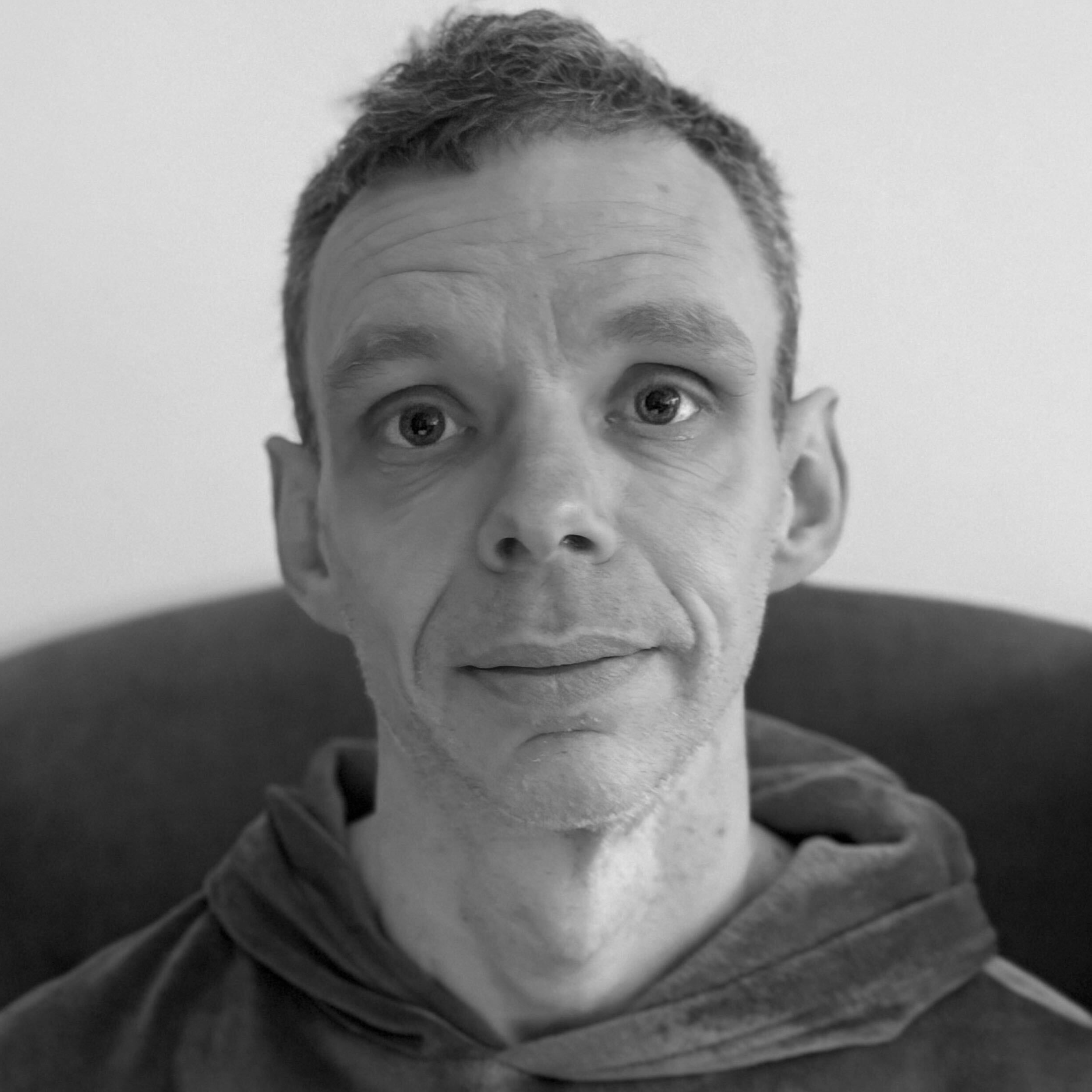
Clayton Rabideau
Cofounder and CEO/CTO
Syntensor is the result of Clayton’s life-long passion for algorithms and biology. After an undergraduate degree in genetics, Clayton’s PhD research was devoted to computational synthetic biology. He launched Syntensor out of Cambridge University’s entrepreneurial ecosystem.
Rosie Higgins
Cofounder and Advisor
Rosie is a product leader who specializes in building multidisciplinary teams to bring emerging technologies to market. Previously, she has been VP at Novartis, Data42 and COO at BenevolentAI, and prior to her move into biotech, built and scaled global brands at London-based startups.
Gabrielle Griffin, PhD
VP, Bioinformatics and Product
Before joining Syntensor, Gabi was Director of Bioinformatics at Sumitovant Biopharma and Lead Bioinformatics and Drug Discovery Scientist at BenevolentAI where she was technical lead for their partnership with AstraZeneca.
Callum Birch-Sykes, PhD
Senior ML Researcher
Previously as a particle physics researcher at CERN, Callum developed GNN models to search for hypothetical Higgs bosons at the LHC. He now applies his background in geometric ML to the biological domain as a researcher at Syntensor.
Annija Jekale
VP Operations
After her MPhil (Management) at the University of Cambridge, Anni started her career as a Wealth Analyst in the city. At Syntensor, she applies her diverse ops toolkit with precision, while wearing many hats.
Chris Heelas
Lead Full-stack Engineer
Chris has dedicated his professional career to mobile systems engineering, holding a degree in Interactive Media. Over the past 25 years, he has honed his expertise in systems architecture, low-latency data streaming, and product engineering within startups. Spanning various domains, including IoT, full-stack development and real-time computer vision.
Craig Cinquina
VP, Business Development
Craig has spent his career building start-ups servicing the financial and pharmaceutical industries. After completing his PhD in Pharmacology at Yale, Craig was an early member at GLG, the world’s largest expert network, where he ultimately led their Healthcare Practice. After GLG, Craig helped the explainable AI companies Aitia and PredxBio grow their presence in the Life Science space.
Tristan Gallent
Machine Learning Researcher
Tristan's work focuses on explainability, long context, and low-level optimization. He joins Syntensor from the Arc Institute.
Maksym Korablyov
ML Ops + Engineering Contributor
Maksym is a PhD candidate in Yoshua Bengio’s lab at MILA where he is building large scale generative models. Prior to MILA, he attended MIT and was a Harvard Medical School Visiting Fulbright Scholar. He holds a Masters in Bioinformatics and studied Genetics as an undergraduate.
Michael Poli
ML Research Contributor
Michael is a PhD candidate at Stanford working at the intersection of deep learning, generative models, numerical methods and control of dynamical systems. He cofounded DiffeqML with Stefano Massaroli and is a core-maintainer of the Torchdyn library for neural differential equations.
Stefano Massaroli
ML Research Contributor
Stefano is a post doc in Yoshua Bengio’s lab at MILA working in deep learning, dynamical systems, optimization & control. He cofounded DiffeqML with Michael Poli and is a core-maintainer of the Torchdyn library for neural differential equations.